Local relining guide
What relining actually is, and when it suits Blacktown
What relining actually is
A liner saturated in resin is drawn into the existing pipe and cured in place, forming a new seamless pipe inside the old one. Every joint along that run is sealed at once, which is the point: it is not patching the spot where the root got in, it is removing every other place a root could get in next.
Access is through existing points wherever possible. Where a new access pit is genuinely needed we will say so and price it before starting, rather than discovering it halfway through.
Why it suits Blacktown blocks specifically
The economics change with the property. On a 600 to 900 square metre block, a sewer run is long, and it usually passes under lawn that has had half a century to establish, sometimes under a driveway or a slab poured decades after the pipe went in.
Excavating that means a trench, then reinstatement: turf that takes a season to match, concrete that never quite does. Relining costs more per metre than digging costs per metre, and still frequently comes out cheaper once you count putting the yard back. That is the comparison worth making, rather than liner price against clearing price.
When we will tell you not to reline
A liner follows the shape of whatever it is cured inside. It cannot correct a pipe sitting at the wrong angle, it cannot bridge a section that has properly collapsed, and it will not fix a run that has sagged enough to hold water.
In those cases excavation is the right answer and we will say so. It is a more expensive conversation for us to have honestly, which is exactly why the camera goes down before anyone quotes anything.
The camera comes first, always
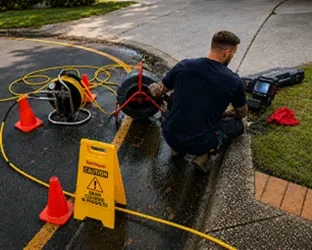
Nobody should quote a liner without having looked. The camera establishes four things: where the fault actually is, how far it sits from the house, what kind of fault it is, and whether the pipe around it will take a liner at all.
You should watch that footage rather than be told about it. If we recommend relining a nine metre section, you should be able to see why it is nine metres and not four, and see the condition of the pipe either side of it. A recommendation you cannot see the basis for is one worth questioning.
The tree question, answered honestly
Almost every root job raises the same question: does the tree have to go? Usually not. A mature tree on a Blacktown block is generally worth more to the property than the drain repair costs, and removing it does not remove the roots already inside the line.
Sealing the joints is what stops the problem, because roots cannot enter a run that has no openings. What the tree does affect is future planting, which is why knowing where the line runs is genuinely useful information to keep after the job is done.
If the offending tree is on council land or a neighbour's property, the repair is still yours. The camera footage is what any conversation with either of them needs to start from.
Patch, or the whole run
Not every line needs lining end to end. Where the camera shows one bad joint in an otherwise sound pipe, a patch liner of half a metre to a couple of metres over that spot is the proportionate repair and costs a fraction of a full run.
A full reline earns its price when the footage shows the whole length is going: multiple open joints, root intrusion at several points, or a pipe that has started to deform. Paying for a full run when a patch would do is the most common way people overspend on this work, and you can see which one you have on the screen yourself.
Junctions, and the step people forget to ask about
A liner goes in as a continuous sleeve, which means it covers the openings where branch lines join the main. Those have to be cut back open afterwards with a robotic cutter, and the reinstatement has to be clean or you have simply moved the blockage to a new place.
On a post-war Blacktown house there are usually more junctions than people expect, because the original line has often been extended for a laundry, a second bathroom or a granny flat added decades later. Ask any quote how junction reinstatement is handled and whether it is included. If the answer is vague, that is worth knowing before you commit.
How long it lasts, and what a warranty is worth
A properly installed liner is rated for a design life of around fifty years, which is longer than the earthenware it is lining ever managed. In practice the liner is not usually what fails. What fails is a junction that was reinstated badly or a section at the very end of the run that was never lined.
So read the warranty for what it actually covers. A warranty on the liner itself is close to meaningless if the reinstatement is excluded. Ours covers the workmanship, and we hand over the before and after footage so there is a record of what was done rather than a claim about it.
Buying an older place around here
If you are buying anything built before about 1980 in this district, a camera down the sewer before exchange is one of the cheaper pieces of due diligence available. A standard building and pest inspection does not go down the drain.
The line is the buyer's problem the moment it is theirs, and on a block with sixty years of tree growth over an earthenware sewer the odds of finding something are not small. Knowing about it beforehand is either a negotiating position or a reason to walk, and either beats finding out the first wet winter.