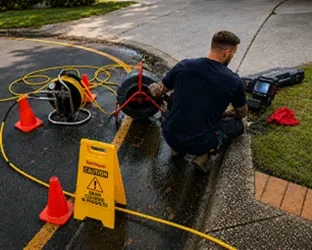
Slow, gurgling, or backing up into the shower? We clear it the same day, then put a camera down if it has happened before. On these blocks a recurring blockage is almost always roots in the old earthenware rather than anything that went down the sink.
Online Now!·--:--
A one-off blockage is usually about what went down: wipes sold as flushable that are not, cooking fat that set as it cooled, a toy posted down by someone small. Those clear properly and stay cleared.
A drain that blocks every few months is a different animal, and it is almost never about the fixture you are standing at. It is a symptom of something further down the line, and on these blocks the answer is usually roots in the old earthenware sewer.
Which half of the district you are in changes the odds before we arrive. The post-war streets through Blacktown, Seven Hills, Lalor Park and Marayong sit on earthenware sewer laid in short lengths with mortared joints, on blocks of 600 to 900 square metres that have had sixty years to grow serious trees over the top of it. Out through Schofields, The Ponds and Riverstone the line is modern PVC in one continuous run, so a repeat blockage there is far more likely to be a fall problem or a builder defect than roots.
So the useful question is not how to clear it. It is whether this is the first time, because that single answer decides whether you need a plumber for an hour or a camera down the line. We will tell you which on the phone rather than sending a jetter to a job that needs a camera.


A blocked drain is a same-day problem when it is the only bathroom in the house. Our vans already work this district rather than driving out from the inner city.
Stop using water anywhere in the house, including the washing machine and dishwasher, because every litre you send down has nowhere to go but up through the lowest fixture. That is usually a shower base or a floor waste rather than the toilet you noticed first.
Then check the overflow gully outside, the grated drain at ground level near the bathroom wall. It is designed to spill there rather than inside. If it is overflowing, the blockage is in the main line rather than the fixture.
The standard block here is 600 to 900 square metres and the standard house went up in the 1950s or 60s, so most of these yards carry five to seven decades of mature planting sitting directly over a sewer laid in short lengths of earthenware with mortared joints.
Roots do not break into sound pipe. They find a joint that has opened a fraction, usually because the reactive clay around it has been swelling and shrinking through every wet and dry season since it was laid. Once a root is in it thickens, catches everything passing, and rebuilds after every clear. That is why the same drain blocks again eight weeks later.
The tree is rarely the villain and removing it is rarely the answer. A mature tree is usually worth more to the property than the drain repair costs, and the roots already in the line do not disappear when the trunk does.
The soil across the district is a highly plastic clay with poor natural drainage. When a stormwater pit or downpipe line is overwhelmed in a heavy western Sydney downpour, the surrounding ground cannot absorb what spills, so it pools and stays.
That is why a yard here can be saturated for days after rain a sandier suburb would have shed in hours. It is normal, and not in itself a plumbing fault. It becomes one when the wet patch is actually a blocked line or a leak.
They are separate networks doing separate jobs, and people routinely describe one when they mean the other. Sewer carries waste from toilets, sinks and showers. Stormwater carries rain off the roof and the paving.
It matters because the fix is different and so is the responsibility. A blocked stormwater pit floods a yard. A blocked sewer backs up inside the house. Telling us which one you are looking at saves a wasted visit.
A drain that gurgles is pulling air through the water sitting in a trap, which happens when the line beyond it is partly blocked and the flow is dragging a vacuum behind it.
Wherever you hear it, the blockage is downstream. A shower that gurgles while the toilet flushes is telling you the fault is in the main line rather than the shower, which saves somebody working on entirely the wrong fixture.
Supermarket drain cleaner is caustic, rarely reaches a blockage sitting well down the line, and does nothing whatsoever to a root mass or a cracked section, which are the two things actually causing the problem out here.
It also sits in the standing water waiting for whoever opens the pipe next. That is why we ask on the phone whether anything has been poured in, and it is a fair question rather than a judgement.
Not on a one-off with an obvious cause. If a drain has blocked once and something identifiable came out of it, that is the end of the story and a camera is an upsell.
If it is the second or third time in a year, the camera stops being optional. It converts guesswork into a picture: where the fault is, how far from the house, what kind it is, and whether the pipe around it is still sound. You should watch that footage rather than hear a summary of it.
Where the barrel of the pipe is sound and the joints are the problem, which describes most of the earthenware around here, a resin liner cured inside the existing pipe seals every joint along the run without a trench.
That matters more on a Blacktown block than most, because a sewer run here is long and usually passes under lawn that has had half a century to establish. Where a section has genuinely collapsed or the fall is wrong, excavation is the honest answer and we will say so.

You get a fixed price before anything starts. These are indicative of the 2026 Sydney market rather than a quote from us.
Hand tools or an electric eel through an existing access point, business hours. Most single blockages sit here.
Where the blockage is compacted or sitting deep, and hand tools will not reach it.
Down the line to find the actual cause. You see the footage, and any quote is built on it.
Driven by how much pipe is affected and how established the root mass is.
Issued with the footage when we camera a line, so you have it for a strata or insurance conversation.

That single answer separates a local blockage from a main-line problem, and decides whether we bring hand tools or the jetter. We also ask what has been poured in.

Drop sheets first. Then the right tool for where the blockage actually sits: a closet auger for the pan, an eel or jetter when it is further down the line.

A first-time blockage with an obvious cause stops here. A repeat offender gets the camera, because on these blocks the recurring ones are a root mass, not a habit.

Roots cut and jetted, a damaged section relined, or an honest recommendation to excavate if that is what the footage supports. Quoted before anything starts.
Stop using water in the house and tell us which fixtures are affected. Knowing whether it is one drain or all of them tells us most of what we need before anyone drives.
Call 1300 381 569
Because clearing it is treating the symptom. A drain that blocks repeatedly is almost never about what went down the sink. On the older Blacktown blocks it is nearly always tree roots that have found a joint in the earthenware sewer, and they grow straight back after every clear. Fifty to seventy years of mature planting over a clay pipe laid in short jointed lengths is exactly the condition roots exploit. That is when the camera earns its money, because clearing it four times a year costs more than fixing it once.
Usually the ground rather than a fault. The soil across Blacktown is a highly plastic clay over shale with genuinely poor natural drainage, so water sits instead of soaking away. That is normal for the district. It becomes a plumbing problem when it is actually a blocked stormwater line, an overwhelmed pit or a leak feeding the wet patch, and telling those apart is worth doing before you spend money on landscaping.
Broadly, the pipes on your property up to the boundary are yours, and the main beyond it is Sydney Water's. Most blockages we clear are well inside the boundary. If a camera shows the fault is on their side we will tell you, because that is a call you make rather than a bill you pay.
Nearly always, yes. An electric eel or a high-pressure jetter clears the blockage through an existing access point, and a camera then shows what caused it. Digging only comes into it when a section has collapsed or the fall is wrong, and in those cases relining is often the alternative to excavation.
Not on the things that actually block drains out here. Supermarket cleaner is caustic, rarely reaches a blockage that sits well down the line, and does nothing at all to roots or a cracked section. It also sits in the standing water waiting for whoever opens the pipe next, which is why we ask on the phone whether anything has been poured in.
As a 2026 guide, a straightforward clear in business hours runs about $150 to $350, a compacted or deeper blockage needing jetter time up to about $400, and after-hours work $350 to $650. A camera inspection for a repeat offender is $300 to $750, and you see the footage.
No, and they are the single most common cause of a blocked sewer we attend. They pass the S-bend, which is all the label really promises, then they do not break down the way paper does. They snag on anything rough in the line, and on a jointed earthenware sewer with roots already in it there is plenty to snag on. Once a few collect, everything else builds behind them. The same goes for kitchen paper towel, cotton buds and cat litter sold as flushable. Paper and what your body produces, nothing else.
Tell us which fixtures are affected and whether it has happened before. If it is a repeat, say so, because that changes what we bring and usually means the camera goes down the same visit.
Fixed price agreed before we start, and you see the footage of anything we recommend.
Online Now!·--:--