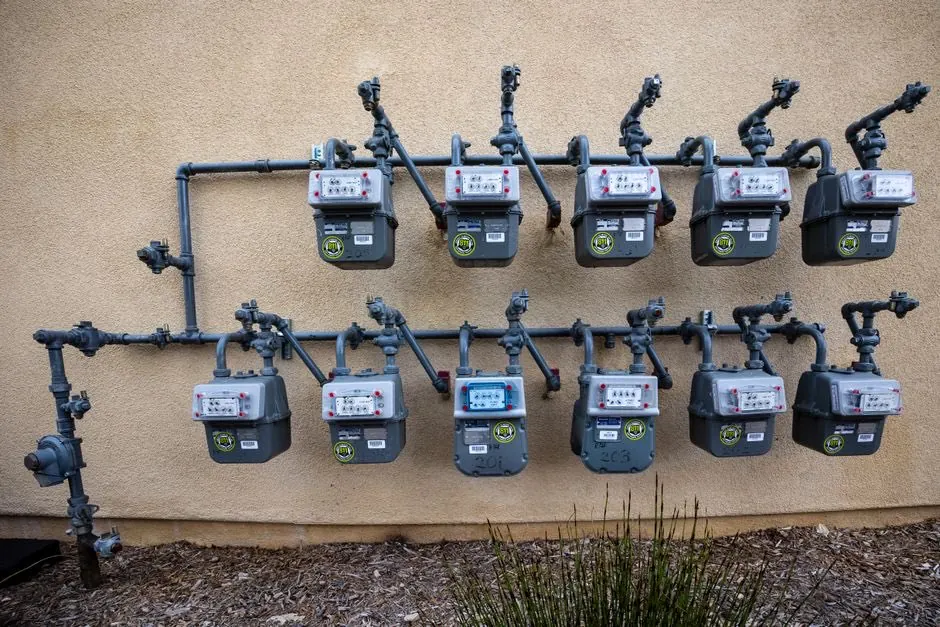
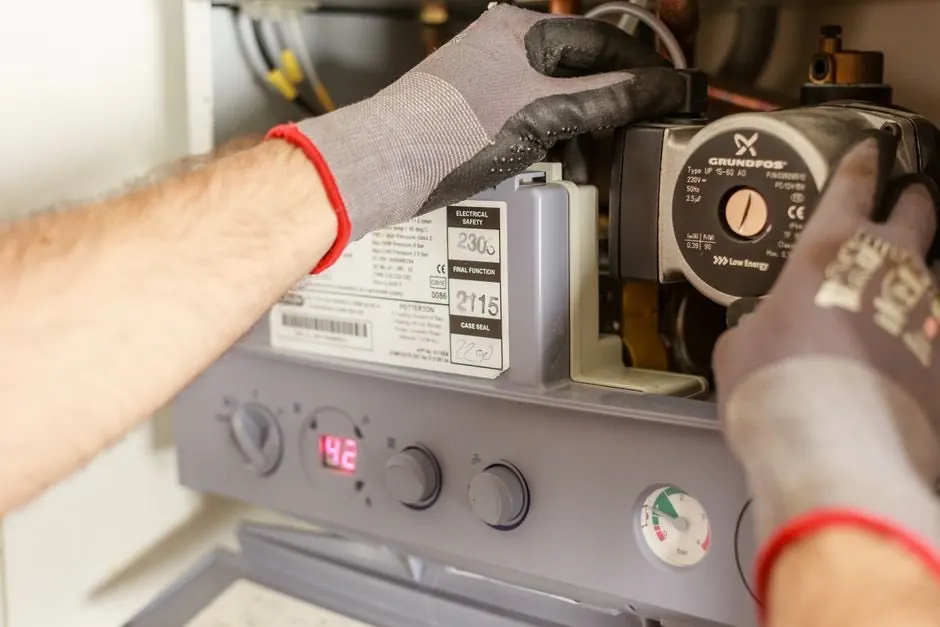
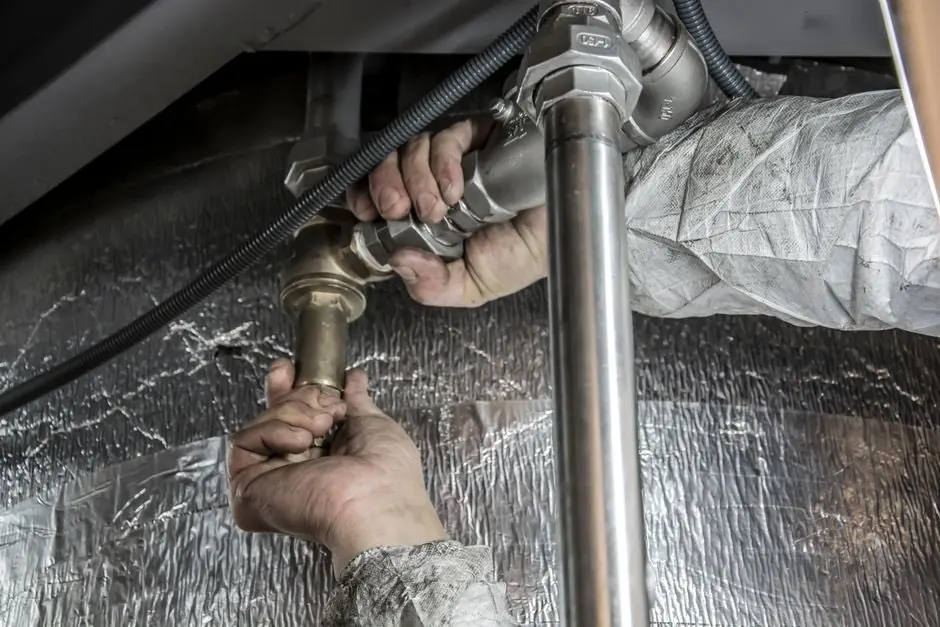
Blacktown is split between older streets where the gas was run decades ago and never mapped, and newer estates built with no gas connection at all. We handle both: leaks traced and made safe, appliances connected and certified, and new points run from the meter across those long suburban blocks.
Online Now!·--:--
Everything else on this page can wait until you have done three things, and none of them need tools or us.
Get everyone outside and keep them out. Touch nothing electrical on the way: no light switches, no appliances, no phone indoors, no flames, no cigarettes. A switch spark is enough to ignite gas that has been collecting in a closed room.
Then call from the footpath, us and the gas emergency line on 131 909. If the meter is safe to reach on your way out, turn the handle a quarter turn so it sits across the pipe.
One thing worth knowing while you wait, because it stops the panic outrunning the problem. Natural gas has no smell at all. The rotten-egg odour is added deliberately, and it is added heavily enough that you can smell a leak long before it reaches a level that is dangerous. Act on a faint smell straight away, but smelling it does not mean you are standing in a bomb.


Get out first, leave the switches alone, and ring from the footpath. Tell us the street and we will have someone heading your way while you are still outside.
Across the post-war streets around Seven Hills, Lalor Park, Marayong and Blacktown itself, gas was run decades ago, extended once or twice since, and never fully mapped. Those runs are usually sound. What they are not is documented, so the line feeding your kitchen may take a route nobody has recorded, and a pergola or a slab may well have been built over part of it.
That is why we test rather than assume. It is also why we ask what has been added to the house since it was built, which is a more useful question out here than it sounds.
Schofields, The Ponds, Riverstone and the newer development toward Marsden Park are increasingly built with no gas connection at all. Whole streets are electric-only by design.
The practical consequence catches people regularly: a gas cooktop or heater bought for a house that has nowhere to connect it. If you are buying an appliance and you are in a newer estate, it is worth five minutes of checking before you pay for it. We can usually tell you from the address.
The clay across the district is highly plastic and swells and shrinks through the seasons. That gets discussed as a water-pipe problem because that is where it shows up visibly, but the same movement works on buried gas lines and on the joints where a run enters the building.
It rarely produces anything dramatic. What it produces is a very small leak at a joint that has been flexed for decades, the kind you smell faintly near the meter on a still morning and not at all by lunchtime. Worth fixing, and cheap while it is still small.
A lot of these homes have bayonet points in the wall for a gas heater, and plenty of those heaters have not been connected for several winters. The fitting is designed to seal with nothing plugged in, and usually it does.
The ones worth checking are points that have been painted over, knocked, or sat behind furniture for years. Test it in March rather than finding out on the first genuinely cold night, when every gas fitter in Sydney is already booked out.
It is a pressure test, not somebody walking around with their nose. We isolate the installation at the meter, put it under pressure, and watch whether it holds. If it does not, the rate of the drop tells us roughly how big the loss is before we have found where it is, which narrows the search considerably.
From there it is methodical section work. The reason this is worth paying for rather than guessing at is that a smell tells you a leak exists but not where it is. Gas travels along the outside of a pipe and up through wall cavities, so the place it smells strongest is frequently not the place it is escaping.
This is the single most common wasted trip we make. An appliance arrives, gets unboxed, and it is set up for the other fuel. They run at different pressures with different injectors, and changing between them needs a conversion kit and a licensed person to fit it.
Reticulated natural gas covers most of the LGA, though not every street. Check the label before you pay rather than after it is delivered.
It reads as obvious written down, and people still do it, usually to check whether a pilot has gone out. The safe version is soapy water brushed onto a joint: it bubbles where gas is escaping and costs nothing.
The other one worth naming is the hardware-store leak spray used to declare a job finished. It will find a leak. It will not tell you the installation holds pressure, which is the thing a compliance certificate actually attests to.

Every job is quoted at a fixed price before anything starts, and these are indicative of the 2026 Sydney market rather than a quote from us. Two things move a gas price here specifically: distance from the meter, because Blacktown blocks are large and the meter usually sits at the boundary, and whether the run has to penetrate a wall that may be lined with bonded asbestos sheeting, which is licensed removal and a separate cost we name before starting.
The installation isolated and put under pressure, and a clear answer on whether it holds.
Cooktop, oven, heater or freestanding unit connected to a point already there, tested and certified.
Where the test fails. The range is wide because a joint at the meter is a very different job to a leak under a slab.
Driven by distance and what the run has to cross. The big blocks here often mean longer runs than an inner-city job.
Issued on every gas job, in your name, before we leave. Not an add-on and not posted out later.

Whether the smell is there now or comes and goes, whether you are on mains gas or bottles, and the age of the house. Those three answers decide whether a van leaves immediately or we book you in, and they tell us what to load.

A live leak gets shut off at the meter the moment we arrive. No diagnosis, no quoting and no repair happens while gas is still escaping into a building.

The whole installation is pressurised so we know first whether it holds at all, and second how fast it is losing. That number tells us where to start looking before we open anything.

The fault is repaired at the figure you already approved, the installation goes back under pressure to prove it, and the certificate is written out in your name on site.
Turn the appliance off, open the doors and windows, leave the switches alone and call us. A licensed gas fitter can talk you through it while the van is moving.
Call 1300 381 569
Everyone outside first, and stay out. Touch nothing electrical on the way: no light switches, no appliances, no phone indoors, no flames. From the footpath, call us and the gas emergency line on 131 909. If the meter is safe to reach on your way past, turn the handle a quarter turn so it sits across the pipe. Worth knowing while you wait: natural gas has no smell of its own, and the rotten-egg odour is added heavily enough that you can smell a leak well before it reaches a dangerous concentration.
Quite possibly not. The growth corridor through Schofields, The Ponds, Riverstone and out toward Marsden Park is increasingly built all-electric, with no gas connection to the street at all. It catches people out when they buy a gas cooktop for a house that has nowhere to connect it. Check before you buy, and if you are not sure, we can tell you from the address.
Yes, and it is not a formality. Gas work must be carried out by a licensed gas fitter and certified afterwards. Unlicensed gas work can void your home insurance, and appliance warranties usually depend on certified installation. We hold NSW licence 368473C and issue a compliance certificate on every gas job.
It affects how we run a new line rather than whether we can. Fibro homes of the 1950s and 60s almost certainly contain bonded asbestos sheeting in wall linings and eaves, and brick veneer through to the 1980s used it too. Running a gas point often means penetrating a wall, so we identify what we are cutting into before we cut, and price licensed removal separately if the sheeting itself has to come out.
As a 2026 guide: a service call and leak test runs about $150 to $350, connecting a cooktop or heater to an existing point about $200 to $450, and running a new point from the meter about $600 to $1,600 depending on distance and what the run has to cross. You get a fixed price before anything starts.
Yes, and it is common. The one thing worth checking before you pay for it is whether it is set up for natural gas or LPG. They run at different pressures with different injectors and are not interchangeable without a conversion kit. Most of Blacktown is on reticulated natural gas, but not all of it.
It is the document a licensed gas fitter issues certifying the work meets AS/NZS 5601. In NSW it has to be lodged with the gas supplier, and a copy goes to you. It matters for three practical reasons: your home insurance can be argued down to nothing if unlicensed gas work is found after an incident, a conveyancer will ask for it when you sell, and it is the only proof the installation was ever tested. We issue one on every gas job, included in the price. If a quote does not mention a certificate, ask why before you accept.
Suspected leak, an appliance waiting in its box, or a new point to run. Tell us the address and the age of the house and we will know most of what we need before we arrive.
Fixed price agreed before anything starts, and the compliance certificate issued before we leave.
Online Now!·--:--