It starts as a chalky white bloom on the bricks a course or two above the ground, and the usual response is to brush it off. It comes back. Eventually the face of the brick starts to flake, the mortar between goes powdery, and something that looked cosmetic turns into something structural.
That is salt. It is common across western Sydney and it is not, in itself, a plumbing fault. But salt only moves when water moves it, and one of the water sources that councils here name explicitly is leaking underground pipes. So the useful question is not what the white stuff is. It is where the water keeping it moving comes from.
The bloom is salt carried to the surface by water moving through the masonry, then left behind when that water evaporates. Salt is already in the ground here. What decides whether you have a problem is whether something is adding water, and a leaking underground pipe is one of the sources council salinity assessments name.
- Look at whether the damage is worst at one point or spread evenly
- Check whether the ground nearby stays damp when it has not rained
- Have the water meter read with everything off
- Rule the plumbing in or out before you repoint anything
- Fix the water source first, or the repair will fail again
On this page
1. What the white bloom actually is
Salts occur naturally in the soils across much of western Sydney. On their own, sitting still, they do nothing at all. They become visible when water moves through the ground and then through porous material like brick, mortar or concrete, carrying dissolved salt with it. When that water reaches a surface and evaporates, the salt cannot evaporate with it, so it is left behind.
That is the white bloom. The damage that follows is mechanical rather than chemical in the way most people assume: the salt crystallises inside the pores of the brick and the mortar, and crystals take up more room than the solution they came from. Repeat that cycle through enough wet and dry seasons and the face of the brick begins to break away from the inside.
The same process attacks mortar, concrete and metal. Council salinity assessments across this area describe exactly this: crumbling, erosion and corrosion, and near creek lines the sulfate content can make it worse.
The two get conflated constantly. Damp is about water. Salinity is about what the water is carrying and what it leaves behind. You can have one without the other, and the fix for each is different.
2. Where the extra water usually comes from
Salt was already in the ground before the house was built. What changed is how much water is available to move it, and urban development changes that in several ways at once: hard surfaces redirect rainfall, gardens are watered, stormwater is concentrated, and some of the water that used to run off now soaks in.
Council salinity investigations in this area also name leaking underground pipes among the sources of that additional water. That is the part a plumber can do something about, and it is the part most often skipped, because the damage shows up on the brickwork and so the brickwork gets the attention.
- A leaking water service. A slow leak on the supply line runs day and night, in every season, which is exactly the steady wetting that keeps salt cycling.
- A cracked or displaced sewer line. Older drainage under a 1960s house can leak at joints without ever backing up inside.
- Stormwater that never reaches a legal point of discharge. A downpipe discharging into the ground beside a wall is a common and entirely fixable cause.
- Irrigation against the wall. Not a plumbing fault, but worth ruling out before anybody starts opening things up.
3. How to tell whether the plumbing is involved
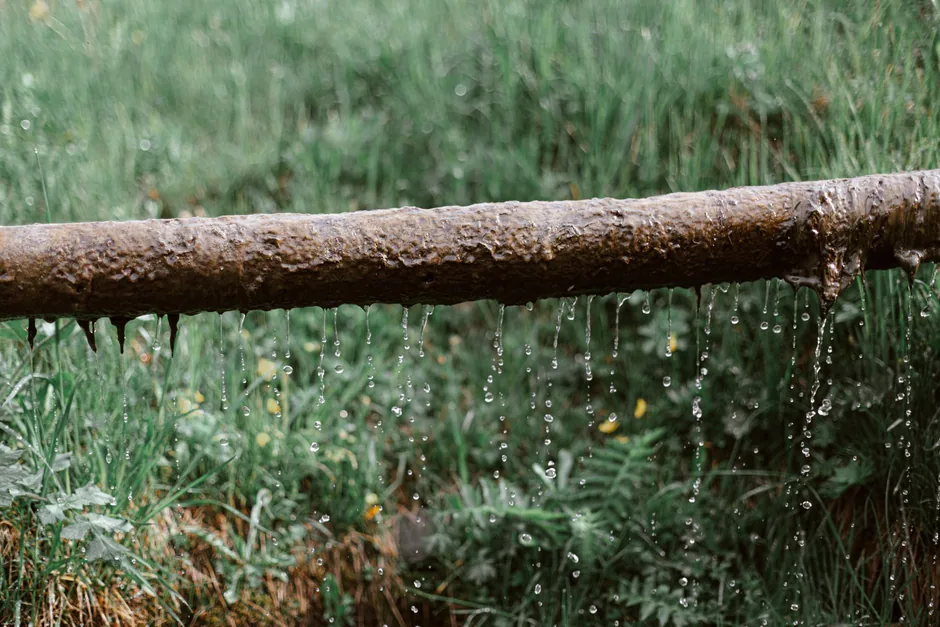
The pattern of the damage is the first clue and costs nothing to read. Salinity driven by general ground conditions tends to appear along a length of wall fairly evenly. Damage that is dramatically worse in one spot, particularly near a tap, a meter, a downpipe or the line of a drain, is pointing at a source.
The second clue is ground that stays damp when it has no reason to. A patch that is still soft a week after the last rain, or grass that is greener over one line, is worth mentioning when you ring somebody.
The third is the meter, and it is the one that settles it. Turn every tap off, make sure nothing is filling, and read the meter. Read it again after an hour with nothing used. Movement means water is going somewhere, and that is no longer a theory about the ground.
It tells you there is a leak. Finding it still takes equipment, because the alternative is digging on a guess, and on a 700 square metre block that is an expensive way to look.
4. Why fixing the wall first wastes the money
This is the part worth being blunt about. Repointing mortar, rendering over the affected courses or replacing damaged bricks all address what the salt has done. None of them address the water that brought it there.
If a leak is supplying that water, the same process starts again on the new work, and because render and modern mortar are often less porous than what they replaced, the salt sometimes just moves to the next weakest point instead. People end up paying twice and concluding the repair was done badly.
The sensible order is: establish whether water is being added, fix that if it is, then repair the masonry. It is slower to start and considerably cheaper to finish.
Not sure whether a leak is feeding it?
We can test the service, read the meter properly and locate a leak without digging the yard up on a guess.
5. What we can settle, and what we cannot
We can tell you whether your water service is losing, locate the loss and repair it. We can camera a sewer or stormwater line and show you the footage rather than describe it. We can move a downpipe discharge to a legal point instead of into the ground beside a wall. Those are the plumbing contributions and they are real ones.
We cannot tell you what the soil is doing, assess the salinity of a site, or price the brickwork. Those belong to a geotechnical or building specialist, and Council is the authority on anything to do with site salinity requirements in this area.
Anyone who tells you confidently that salt damage on a wall is definitely a plumbing problem, without having read a meter or put a camera down anything, is guessing at your expense. So is anyone who tells you it definitely is not.
6. What to do this week
- Photograph the affected area, with something in frame for scale, and date it. A month of photos is more useful than any single description.
- Walk the perimeter after a dry week and note anywhere the ground is still soft.
- Check where every downpipe actually discharges, not where you assume it does.
- Do the meter test: everything off, read, wait an hour, read again.
- If the meter moved, get the leak located before anyone touches the wall.
- If it did not, the wall is still worth attending to, but the cause is somebody else's field rather than ours.
None of that costs anything except attention, and it turns a vague worry about the house into a short list of facts that a tradesperson can act on.
- The white bloom is salt left behind when water carrying it evaporates out of the masonry.
- Salt is already in the ground here. What varies is how much water is available to move it.
- Council salinity work in this area names leaking underground pipes among the water sources.
- Damage worst at one point, near a tap, a meter or a drain line, is pointing at a source.
- Read the meter with everything off. Movement means a leak, and that is a plumbing question.
- Fix the water source before repairing the masonry, or you will pay for the masonry twice.
Salt damage on brickwork FAQs
Is the white powder dangerous?
Not to you. It is a salt deposit, not a mould or a contaminant. The problem it causes is structural rather than a health one: the crystals break the face off brick and turn mortar powdery over time.
Can I just seal the wall?
Sealing traps the water rather than removing it, and the salt then crystallises behind the seal or moves to whatever the next porous surface is. It can make things look better for a season and worse afterwards. Deal with the water first.
How do I know if my water service is leaking?
Turn everything off, including anything that refills like a cistern or an ice maker, and read the water meter. Read it again an hour later with nothing used. If the number has moved, water is leaving the system somewhere.
Could it be the sewer rather than the water main?
It can be. A sewer line that has cracked or pulled apart at a joint can leak steadily into the ground without ever causing a backup inside the house, which is why it goes unnoticed for years. A camera inspection answers it.
Does this mean the house is subsiding?
No. Salt damage and ground movement are separate things that sometimes appear together because both involve water. We are not the right people to assess movement, and anybody who diagnoses it from a photograph of brickwork is overreaching.
Is this covered by insurance?
That depends entirely on your policy and on the cause, and it is worth asking your insurer directly rather than us. What helps any claim is evidence: dated photographs, a meter test and, where relevant, camera footage of the drain.